 Shivam MishraandGitHub
94daf26ead
Shivam MishraandGitHub
94daf26ead
This PR updates two dependencies — `faraday` (2.14.1 → 2.14.2) and `jwt`
(2.10.1 → 2.10.3) — to pick up security patches flagged by
`bundle-audit`. Both are bumped to the minimal patched release within
their existing major lines to keep the blast radius small.

### Faraday

`Faraday::Connection#build_exclusive_url` still allowed a
protocol-relative host override when the request target was passed as a
`URI` object (rather than a `String`), bypassing the earlier fix for the
string-based variant (CVE-2026-25765 / GHSA-33mh-2634-fwr2). On a
fixed-base connection this could redirect a request to an
attacker-controlled host while still forwarding connection-scoped
headers such as `Authorization` — i.e. off-host request forgery
(CVE-2026-33637 / GHSA-5rv5-xj5j-3484).

The fix is a clean patch bump to `2.14.2`, within Faraday's existing
version range — no API changes and no other gems affected.

### JWT

`jwt` 2.10.1 accepts an empty/`nil` HMAC key during verification:
`JWT.decode(token, "", true, algorithm: 'HS256')` (and keyfinder paths
returning `""`/`nil`) verify a forged token, because the empty-key HMAC
digest is treated as valid and `enforce_hmac_key_length` defaults to
`false` (CVE-2026-45363, High).

The advisory offers two fixes — `~> 2.10.3` or `>= 3.2.0`. We chose
**2.10.3** deliberately: jumping to 3.x cascaded into upgrading
`oauth2`, `twilio-ruby`, `googleauth`, `web-push`, and `signet` (all
pinned `jwt < 3.0`), and `jwt` is used directly in 8+ places here (token
services, OAuth callbacks, integration helpers), so a major bump carries
real breakage risk for no extra security benefit. The Gemfile is pinned
`'~> 2.10', '>= 2.10.3'` to hold the 2.x line.

**Spec changes.** 2.10.3 tightens key handling: HMAC sign/verify now
raises on a `nil`, empty, or non-`String` key instead of silently
coercing it. A few specs relied on the old lax behaviour and needed
updating:

- `microsoft` / `google` callback specs built unsigned ID tokens via
`JWT.encode(payload, false)`. Replaced with the correct unsigned form,
`JWT.encode(payload, nil, 'none')`.
- `instagram` / `linear` / `shopify` helper specs have a "client secret
not configured" context where `client_secret` is `nil`. Their shared
`valid_token` `let` signed with that `nil` secret, which Ruby evaluates
before the helper runs — now raising. Since the helper short-circuits on
the blank secret and never decodes the token, those contexts now
override `valid_token` with a throwaway string.

**Production is unaffected.** Every production HMAC path uses a real,
non-empty key — `Rails.application.secret_key_base` (`BaseTokenService`,
`Widget::TokenService`) or a client secret guarded by `return if
client_secret.blank?` (Instagram/TikTok/Shopify/Linear helpers). The one
`nil`-key call, `JWT.decode(id_token, nil, false)` in
`OauthCallbackController`, runs with verification disabled, so the key
is never inspected. Twilio voice tokens use `Twilio::JWT::AccessToken`
from `twilio-ruby`, not this gem. The specs failed precisely because
they exercised the unsafe empty-key pattern the patch now blocks —
production never did.


Chatwoot
The modern customer support platform, an open-source alternative to Intercom, Zendesk, Salesforce Service Cloud etc.













Chatwoot is the modern, open-source, and self-hosted customer support platform designed to help businesses deliver exceptional customer support experience. Built for scale and flexibility, Chatwoot gives you full control over your customer data while providing powerful tools to manage conversations across channels.
✨ Captain – AI Agent for Support
Supercharge your support with Captain, Chatwoot’s AI agent. Captain helps automate responses, handle common queries, and reduce agent workload—ensuring customers get instant, accurate answers. With Captain, your team can focus on complex conversations while routine questions are resolved automatically. Read more about Captain here.
💬 Omnichannel Support Desk
Chatwoot centralizes all customer conversations into one powerful inbox, no matter where your customers reach out from. It supports live chat on your website, email, Facebook, Instagram, Twitter, WhatsApp, Telegram, Line, SMS etc.
📚 Help center portal
Publish help articles, FAQs, and guides through the built-in Help Center Portal. Enable customers to find answers on their own, reduce repetitive queries, and keep your support team focused on more complex issues.
🗂️ Other features
Collaboration & Productivity
- Private Notes and @mentions for internal team discussions.
- Labels to organize and categorize conversations.
- Keyboard Shortcuts and a Command Bar for quick navigation.
- Canned Responses to reply faster to frequently asked questions.
- Auto-Assignment to route conversations based on agent availability.
- Multi-lingual Support to serve customers in multiple languages.
- Custom Views and Filters for better inbox organization.
- Business Hours and Auto-Responders to manage response expectations.
- Teams and Automation tools for scaling support workflows.
- Agent Capacity Management to balance workload across the team.
Customer Data & Segmentation
- Contact Management with profiles and interaction history.
- Contact Segments and Notes for targeted communication.
- Campaigns to proactively engage customers.
- Custom Attributes for storing additional customer data.
- Pre-Chat Forms to collect user information before starting conversations.
Integrations
- Slack Integration to manage conversations directly from Slack.
- Dialogflow Integration for chatbot automation.
- Dashboard Apps to embed internal tools within Chatwoot.
- Shopify Integration to view and manage customer orders right within Chatwoot.
- Use Google Translate to translate messages from your customers in realtime.
- Create and manage Linear tickets within Chatwoot.
Reports & Insights
- Live View of ongoing conversations for real-time monitoring.
- Conversation, Agent, Inbox, Label, and Team Reports for operational visibility.
- CSAT Reports to measure customer satisfaction.
- Downloadable Reports for offline analysis and reporting.
Documentation
Detailed documentation is available at chatwoot.com/help-center.
Translation process
The translation process for Chatwoot web and mobile app is managed at https://translate.chatwoot.com using Crowdin. Please read the translation guide for contributing to Chatwoot.
Branching model
We use the git-flow branching model. The base branch is develop.
If you are looking for a stable version, please use the master or tags labelled as v1.x.x.
Deployment
Heroku one-click deploy
Deploying Chatwoot to Heroku is a breeze. It's as simple as clicking this button:
Follow this link to understand setting the correct environment variables for the app to work with all the features. There might be breakages if you do not set the relevant environment variables.
DigitalOcean 1-Click Kubernetes deployment
Chatwoot now supports 1-Click deployment to DigitalOcean as a kubernetes app.
Other deployment options
For other supported options, checkout our deployment page.
Security
Looking to report a vulnerability? Please refer our SECURITY.md file.
Community
If you need help or just want to hang out, come, say hi on our Discord server.
Contributors
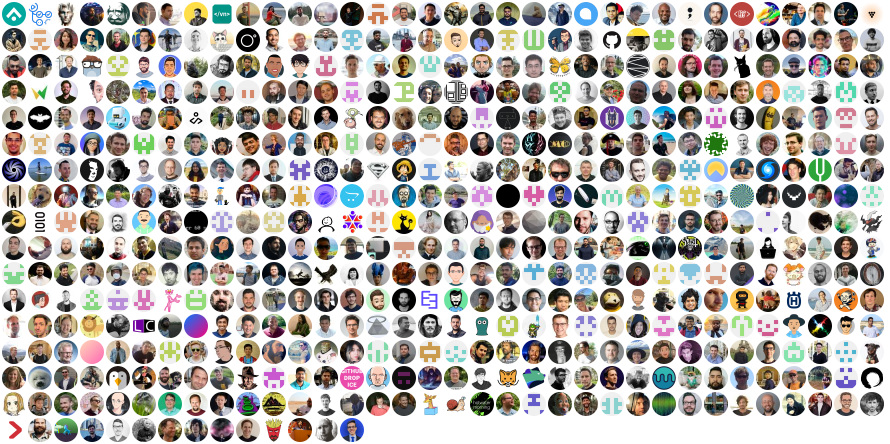
Thanks goes to all these wonderful people:
Chatwoot © 2017-2026, Chatwoot Inc - Released under the MIT License.