 9328f8739c
Deleting a manually-configured WhatsApp Cloud inbox left its
phone-number-level webhook override still pointing at Chatwoot on Meta's
side. The number kept routing inbound events to us after the inbox was
gone, which blocked the customer's own app — subscribed separately on
the same WABA — from receiving messages, since the phone-level override
takes priority over the app-level subscription. Deleting the inbox now
releases the override, as it already did for embedded-signup inboxes.

## What changed

The setup and teardown paths gated on opposite halves of the same
condition. `Channel::Whatsapp#should_auto_setup_webhooks?` sets the
override for `whatsapp_cloud` inboxes where `source !=
'embedded_signup'` (i.e. manual ones), while
`Whatsapp::WebhookTeardownService#should_teardown_webhook?` only cleared
it when `source == 'embedded_signup'`. The two sets are disjoint, so
manual inboxes were exactly the ones that set an override on create and
never cleared it on destroy. Embedded-signup inboxes were unaffected
because `EmbeddedSignupService` calls `setup_webhooks` explicitly.

Dropping the `source` check from the teardown guard is the whole fix.
Manual `whatsapp_cloud` channels can't persist without `api_key`,
`phone_number_id` and `business_account_id` (`validate_provider_config`
verifies all three against Meta), so the remaining presence guards and
both API calls have everything they need. The WABA-level `DELETE
/subscribed_apps` now also fires for manual inboxes when the last one on
a WABA is removed, which is symmetric with manual setup subscribing the
app in the first place; the token only unsubscribes the app it belongs
to, so a customer's separate app subscription is untouched.

This fixes the leak going forward. Numbers already stranded still need
the override cleared with the customer's own token, since we no longer
hold their `api_key` once the inbox is deleted.

## How to reproduce

1. Create a WhatsApp Cloud inbox using manual API keys (not embedded
signup).
2. Confirm the override is set: `GET
/v22.0/{phone_number_id}?fields=webhook_configuration` shows
`phone_number` pointing at your Chatwoot install.
3. Delete the inbox.
4. Before this change, the override still points at Chatwoot. After it,
`webhook_configuration` no longer carries the phone-level override and
events fall back to the WABA/app-level subscription.

---------

Co-authored-by: Muhsin Keloth <muhsinkeramam@gmail.com>


Chatwoot
The modern customer support platform, an open-source alternative to Intercom, Zendesk, Salesforce Service Cloud etc.













Chatwoot is the modern, open-source, and self-hosted customer support platform designed to help businesses deliver exceptional customer support experience. Built for scale and flexibility, Chatwoot gives you full control over your customer data while providing powerful tools to manage conversations across channels.
✨ Captain – AI Agent for Support
Supercharge your support with Captain, Chatwoot’s AI agent. Captain helps automate responses, handle common queries, and reduce agent workload—ensuring customers get instant, accurate answers. With Captain, your team can focus on complex conversations while routine questions are resolved automatically. Read more about Captain here.
💬 Omnichannel Support Desk
Chatwoot centralizes all customer conversations into one powerful inbox, no matter where your customers reach out from. It supports live chat on your website, email, Facebook, Instagram, Twitter, WhatsApp, Telegram, Line, SMS etc.
📚 Help center portal
Publish help articles, FAQs, and guides through the built-in Help Center Portal. Enable customers to find answers on their own, reduce repetitive queries, and keep your support team focused on more complex issues.
🗂️ Other features
Collaboration & Productivity
- Private Notes and @mentions for internal team discussions.
- Labels to organize and categorize conversations.
- Keyboard Shortcuts and a Command Bar for quick navigation.
- Canned Responses to reply faster to frequently asked questions.
- Auto-Assignment to route conversations based on agent availability.
- Multi-lingual Support to serve customers in multiple languages.
- Custom Views and Filters for better inbox organization.
- Business Hours and Auto-Responders to manage response expectations.
- Teams and Automation tools for scaling support workflows.
- Agent Capacity Management to balance workload across the team.
Customer Data & Segmentation
- Contact Management with profiles and interaction history.
- Contact Segments and Notes for targeted communication.
- Campaigns to proactively engage customers.
- Custom Attributes for storing additional customer data.
- Pre-Chat Forms to collect user information before starting conversations.
Integrations
- Slack Integration to manage conversations directly from Slack.
- Dialogflow Integration for chatbot automation.
- Dashboard Apps to embed internal tools within Chatwoot.
- Shopify Integration to view and manage customer orders right within Chatwoot.
- Use Google Translate to translate messages from your customers in realtime.
- Create and manage Linear tickets within Chatwoot.
Reports & Insights
- Live View of ongoing conversations for real-time monitoring.
- Conversation, Agent, Inbox, Label, and Team Reports for operational visibility.
- CSAT Reports to measure customer satisfaction.
- Downloadable Reports for offline analysis and reporting.
Documentation
Detailed documentation is available at chatwoot.com/help-center.
Translation process
The translation process for Chatwoot web and mobile app is managed at https://translate.chatwoot.com using Crowdin. Please read the translation guide for contributing to Chatwoot.
Branching model
We use the git-flow branching model. The base branch is develop.
If you are looking for a stable version, please use the master or tags labelled as v1.x.x.
Deployment
Heroku one-click deploy
Deploying Chatwoot to Heroku is a breeze. It's as simple as clicking this button:
Follow this link to understand setting the correct environment variables for the app to work with all the features. There might be breakages if you do not set the relevant environment variables.
DigitalOcean 1-Click Kubernetes deployment
Chatwoot now supports 1-Click deployment to DigitalOcean as a kubernetes app.
Other deployment options
For other supported options, checkout our deployment page.
Security
Looking to report a vulnerability? Please refer our SECURITY.md file.
Community
If you need help or just want to hang out, come, say hi on our Discord server.
Contributors
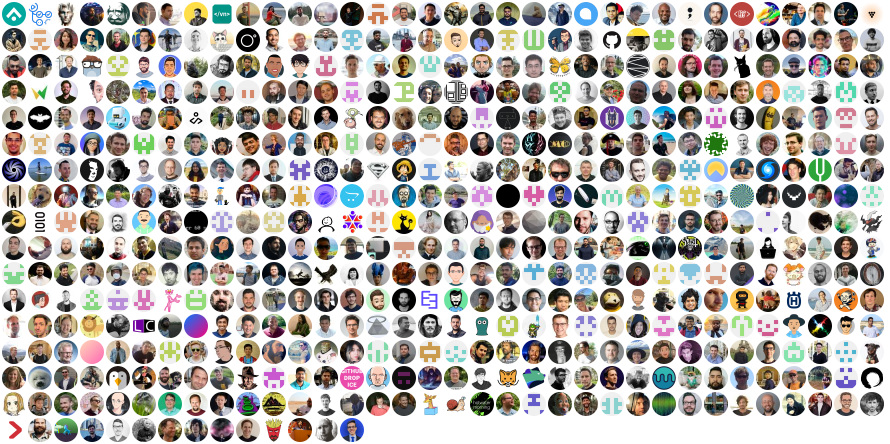
Thanks goes to all these wonderful people:
Chatwoot © 2017-2026, Chatwoot Inc - Released under the MIT License.