## Description

Adds an API-only branded email layout feature for Email inbox replies.
Administrators can configure an account-level fallback layout and
per-email-inbox overrides with Liquid HTML using `{{ content_for_layout
}}`, and eligible outbound email replies/transcripts render through the
scoped layout when the account feature flag `branded_email_templates` is
enabled.

The feature is disabled by default and is manually controlled through
the normal account feature flag mechanism.

Fixes
https://linear.app/chatwoot/issue/CW-7514/branded-html-email-templates-per-inboxbrand

## Type of change

- [x] New feature (non-breaking change which adds functionality)
- [x] This change requires a documentation update

## How to test

1. Start Chatwoot locally and sign in as an administrator.
2. Enable the account feature flag for the account you are testing:

   ```ruby
   account = Account.find(<account_id>)
   account.enable_features!(:branded_email_templates)
   ```

3. Create or pick an Email inbox, then note the `account_id` and
`inbox_id`.
4. Configure an account-level fallback layout through the API using
authenticated admin headers:

   ```http
   PATCH /api/v1/accounts/:account_id/branded_email_layout
   Content-Type: application/json

   {
"branded_email_layout": "<html><body><header>Account Brand</header>{{
content_for_layout }}<footer>Account footer</footer></body></html>"
   }
   ```

5. Confirm `GET /api/v1/accounts/:account_id/branded_email_layout`
returns the saved account layout.
6. Configure an inbox-level override for the Email inbox:

   ```http
   PATCH /api/v1/accounts/:account_id/inboxes/:inbox_id
   Content-Type: application/json

   {
"branded_email_layout": "<html><body><header>Inbox Brand</header>{{
content_for_layout }}<footer>Inbox footer</footer></body></html>"
   }
   ```

7. Confirm `GET /api/v1/accounts/:account_id/inboxes/:inbox_id` returns
the inbox `branded_email_layout`.
8. Send an Email inbox reply and verify the outbound email body is
wrapped with the inbox layout around the generated reply content.
9. Clear the inbox layout by sending a blank value, then send another
reply and verify it falls back to the account layout:

   ```http
   PATCH /api/v1/accounts/:account_id/inboxes/:inbox_id
   Content-Type: application/json

   {
     "branded_email_layout": ""
   }
   ```

10. Clear the account layout with a blank value and verify Email replies
return to the existing no-layout behavior.
11. Verify validation behavior:
- Updating either API with a layout that omits `{{ content_for_layout
}}` returns `422`.
    - Updating either API with invalid Liquid returns `422`.
- Updating a non-Email inbox with `branded_email_layout` returns `422`.
- Disabling `branded_email_templates` and updating a layout returns
`422`.

## How Has This Been Tested?

Validation:

- `bundle exec rspec spec/models/email_template_spec.rb
spec/controllers/api/v1/accounts/branded_email_layouts_controller_spec.rb
spec/controllers/api/v1/accounts/inboxes_controller_spec.rb
spec/lib/email_templates/db_resolver_service_spec.rb
spec/mailers/conversation_reply_mailer_spec.rb`
- `bundle exec rspec
spec/enterprise/services/enterprise/billing/handle_stripe_event_service_spec.rb
spec/enterprise/services/internal/reconcile_plan_config_service_spec.rb`
- `bundle exec rubocop` on changed Ruby files, excluding generated
`db/schema.rb`
- `git diff --check` and `git diff --cached --check`
- YAML parsing for changed config/Swagger files
- `bundle exec rails routes -g branded_email_layout`

## Checklist:

- [x] My code follows the style guidelines of this project
- [x] I have performed a self-review of my code
- [x] I have made corresponding changes to the documentation
- [x] I have added tests that prove my fix is effective or that my
feature works
- [x] New and existing unit tests pass locally with my changes
- [ ] I have commented on my code, particularly in hard-to-understand
areas
- [ ] My changes generate no new warnings
- [ ] Any dependent changes have been merged and published in downstream
modules
This gates API-token access and outgoing account webhooks behind the
`api_and_webhooks` account feature introduced in #14972. On Chatwoot
Cloud, Hacker accounts lose token-authenticated account API access and
account webhook delivery, while paid accounts retain them through the
billing-plan feature reconcile. Community and self-hosted installations
continue to work without any upgrade-time interruption.

## What changed

- Added `Account#api_and_webhooks_enabled?` as the single backend kill
switch. Core returns enabled; the Enterprise override consults the
account flag on Chatwoot Cloud and remains enabled off-Cloud.
- Account-scoped v1 and v2 requests authenticated with a user or
agent-bot API token now return `403 Forbidden` when the feature is
disabled. Invalid tokens still return 401, and dashboard session
requests are unaffected.
- Profile responses return an empty access token when none of the user's
accounts has access. The stored token is preserved, and the profile UI
disables its token controls with paid-plan copy on Cloud.
- Account webhook delivery stops when the feature is disabled. Webhook
CRUD remains available to session-authenticated dashboard requests,
API-inbox webhooks continue to be delivered, and the Cloud dashboard
shows a webhook paywall instead of the webhook list.
- Removed the database backfill migration. Existing paid Cloud accounts
should be enabled with the one-off script below before enforcement is
deployed.

## Existing paid-account rollout

Run this as an ad-hoc Rails runner script on Chatwoot Cloud. It
intentionally targets only the Startups, Business, and Enterprise plans
and does not add `api_and_webhooks` to `manually_managed_features`, so
future billing reconciles remain authoritative.

```rb
paid_plan_names = %w[Startups Business Enterprise]
accounts = Account.where("custom_attributes ->> 'plan_name' IN (?)", paid_plan_names)

total = accounts.count
enabled = 0
skipped = 0

puts "Enabling api_and_webhooks for #{total} paid account(s)..."

accounts.find_each(batch_size: 500).with_index(1) do |account, processed|
  if account.feature_enabled?('api_and_webhooks')
    skipped += 1
  else
    account.enable_features!('api_and_webhooks')
    enabled += 1
  end

  puts "Processed #{processed}/#{total}..." if (processed % 1000).zero?
end

puts "Done! Enabled: #{enabled}, Skipped: #{skipped}, Total: #{total}"
```

For example, save the snippet outside the repository as
`enable_api_and_webhooks.rb`, then run:

```sh
bundle exec rails runner /path/to/enable_api_and_webhooks.rb
```

## How to test

- On Cloud, use a Hacker account and confirm token-authenticated
requests to account-scoped v1 and v2 endpoints return 403, while the
same dashboard actions continue to work through session authentication.
- Confirm profile access-token controls are disabled with paid-plan copy
when all accounts are ineligible, and remain available when at least one
account has the feature.
- Confirm the Webhooks settings page shows the billing paywall for a
Cloud account without the feature; admins get the billing action and
agents get the existing ask-an-admin message.
- Confirm outgoing account webhooks stop for an ineligible Cloud account
while API-inbox webhooks still deliver.
- Confirm community and self-hosted installations retain API and webhook
behavior after upgrading, even when an existing account does not have
the stored feature bit.


### Screenshots

## Cloud

<img width="2590" height="642" alt="CleanShot 2026-07-15 at 15 13 14@2x"
src="https://github.com/user-attachments/assets/431a7bd8-1742-4e7a-b312-d3ad92015f9b"
/>

<img width="2152" height="994" alt="CleanShot 2026-07-15 at 15 14 37@2x"
src="https://github.com/user-attachments/assets/475dda48-d1c5-4be5-a3c3-7a96b9713724"
/>

---------

Co-authored-by: Muhsin Keloth <muhsinkeramam@gmail.com>
## Summary

Keeps Agent Bot list and show access available to agents while
restricting account bot access tokens to administrators.

## Why

Agents need Agent Bot metadata for existing product workflows, but the
bot access token can be replayed against bot-authorized APIs and should
not be exposed to them.

## What changed

- serialize `access_token` only for administrators
- verify agents can read Agent Bot metadata without receiving the token
- verify administrators still receive the token from index and show
responses

## Validation

`bundle exec rspec
spec/controllers/api/v1/accounts/agent_bots_controller_spec.rb`

27 examples, 0 failures.

Related follow-up:
[CW-7595](https://linear.app/chatwoot/issue/CW-7595/standardize-one-time-credential-disclosure-across-chatwoot-apis)


---------

Co-authored-by: Gaurav Singhal <gauravsinghal@Gauravs-Mac-mini.local>
Co-authored-by: Sojan Jose <sojan@pepalo.com>
## Linear ticket
- https://linear.app/chatwoot/issue/CW-7253/billing-brl-pix-new-users

## Description

New accounts that sign up in Brazilian Portuguese are now billed in BRL
instead of USD. Their Stripe customer is created with a Brazil address
and Portuguese locale (so the Stripe portal offers Real prices and PIX),
and the AI credit top-up flow shows packages priced in the account's
billing currency. Currency support is config-driven, so adding another
currency later is a configuration change rather than a code change.


## Type of change

- [ ] New feature (non-breaking change which adds functionality)

## How Has This Been Tested?

- https://www.loom.com/share/c8d3d08c1b844ed6b820438d4209491a

## Screenshot
<img width="904" height="440" alt="image"
src="https://github.com/user-attachments/assets/6f19fad8-e6af-46ea-b99f-b0265bb9eeec"
/>


## Checklist:

- [ ] My code follows the style guidelines of this project
- [ ] I have performed a self-review of my code
- [ ] I have commented on my code, particularly in hard-to-understand
areas
- [ ] I have made corresponding changes to the documentation
- [ ] My changes generate no new warnings
- [ ] I have added tests that prove my fix is effective or that my
feature works
- [ ] New and existing unit tests pass locally with my changes
- [ ] Any dependent changes have been merged and published in downstream
modules
Adds a company selector to the contact details form so agents can
associate a contact with an existing company directly from the contact
page.

Closes

- None

Why

Contacts already expose company information through the CRM fields, but
the form only accepted free-text company names. As we split company CRM
work into smaller PRs, this keeps the contact page aligned with the
structured company model while preserving the existing company-name
behavior used by automations.

What changed

- Shows a company dropdown in the contact details form when the
Companies feature is enabled.
- Keeps legacy free-text company names editable when a contact has no
structured `company_id`.
- Allows Enterprise contact create/update APIs to accept account-scoped
`company_id`.
- Syncs `additional_attributes.company_name` when a contact is
associated with a company, including the existing email-domain
auto-association path.
- Serializes `company_id` in the contact model payload so the form can
show the current association.

How to test

1. Enable Companies for an account and open a contact details page.
2. In Edit contact details, use the Company field to select an existing
company.
3. Save the contact and refresh the page.
4. Confirm the selected company remains visible and the contact is
associated with that company.
5. Confirm contacts with only a legacy free-text company name still show
the text input instead of an empty selector.

---------

Co-authored-by: Sivin Varghese <64252451+iamsivin@users.noreply.github.com>
Co-authored-by: iamsivin <iamsivin@gmail.com>
Co-authored-by: Sony Mathew <2040199+sony-mathew@users.noreply.github.com>
## Summary
The `GET /api/v1/accounts/:id/integrations/apps` endpoint returns raw
secret values (OpenAI API keys, Google service account private keys,
Linear refresh tokens, etc.) in hook settings within the JSON response.
Although gated behind an administrator check, these secrets are visible
in the browser network tab.
This PR filters hook settings through the existing `visible_properties`
whitelist defined in `config/integration/apps.yml`, and adds explicit
whitelists to integrations that were missing them.
Closes#14042
## Bug reproduction
**Setup:** Created an OpenAI integration hook with a fake API key
(`sk-test-secret-12345`).
**Step 1 — Browser Network tab shows raw secrets:**
<img width="1676" height="869" alt="Screenshot 2026-04-24 at 14 32 28"
src="https://github.com/user-attachments/assets/6fc69463-365e-458b-b216-98a7390bf528"
/>
Navigate to Settings > Integrations as an admin. Open DevTools Network
tab and observe the response from `GET
/api/v1/accounts/:id/integrations/apps`. The hook settings contain the
full API key in plaintext:
```json
"hooks": [
{
"id": 1,
"app_id": "openai",
"settings": {
"api_key": "sk-test-secret-12345",
"label_suggestion": false
}
}
]
```
**Step 2 — API call confirms the leak:**
```bash
curl -s "http://localhost:3000/api/v1/accounts/2/integrations/apps" \
-H "access-token: <token>" \
-H "client: <client>" \
-H "uid: user@test.com" \
| jq '.payload[] | select(.id == "openai") | {id, name, hooks: [.hooks[] | {id, app_id, settings}]}'
```
Response:
```json
{
"id": "openai",
"name": "OpenAI",
"hooks": [
{
"id": 1,
"app_id": "openai",
"settings": {
"api_key": "sk-test-secret-12345",
"label_suggestion": false
}
}
]
}
```
Any admin user can extract the raw API key from the response. The same
applies to other integrations — Dialogflow exposes full Google service
account credentials, Linear exposes refresh tokens, etc.
## After fix
After applying this change, the GET
/api/v1/accounts/:id/integrations/apps endpoint no longer returns
sensitive secret values in hook settings. Instead, the response is
filtered using each integration’s visible_properties whitelist, ensuring
only safe, user-facing fields are exposed. For example, OpenAI
integrations return non-sensitive fields like label_suggestion while
excluding raw API keys. This prevents secrets from being exposed in the
browser network tab or API responses, even for authenticated admin
users.
```bash
curl -X GET "http://localhost:3000/api/v1/accounts/2/integrations/apps" \
-H "Accept: application/json" \
-H "Authorization: Bearer eyJhY2Nlc3MtdG9rZW4iOiJqZG5jOWg4TnljaWFJa3JlZkxGQzRnIiwidG9rZW4tdHlwZSI6IkJlYXJlciIsImNsaWVudCI6Ik81bjVnTDFEOVVhbGpwbWxjaHZNanciLCJleHBpcnkiOiIxNzgyMzMyNTA4IiwidWlkIjoidXNlckB0ZXN0LmNvbSJ9" \
-H "access-token: jdnc9h8NyciaIkrefLFC4g" \
-H "client: O5n5gL1D9UaljpmlchvMjw" \
-H "uid: user@test.com" \
| jq '.payload[] | select(.id == "openai") | {id, name, hooks: [.hooks[] | {id, app_id, settings}]}'
% Total % Received % Xferd Average Speed Time Time Time Current
Dload Upload Total Spent Left Speed
100 10174 100 10174 0 0 33232 0 --:--:-- --:--:-- --:--:-- 33357
{
"id": "openai",
"name": "OpenAI",
"hooks": [
{
"id": 1,
"app_id": "openai",
"settings": {
"label_suggestion": false
}
}
]
}
```
## What changed
- Added `visible_properties` accessor to `Integrations::App` model to
expose the whitelist from config
- Updated `_hook.json.jbuilder` to filter `resource.settings` through
the associated app's `visible_properties` instead of returning the full
hash
- Added `visible_properties` to integrations that were missing it:
- Linear: `[]` (settings contain refresh_token)
- Notion: `[]` (OAuth-based, no user-facing settings)
- Slack: `['channel_name']` (UI needs this to display connected channel)
- Shopify: `[]` (no settings)
App config metadata (`_app.json.jbuilder`) is left unchanged —
hook_type, settings_form_schema, etc. are not secrets and the frontend
depends on them.
## How to test
1. Create an OpenAI integration hook with an API key
2. As an admin, call `GET /api/v1/accounts/:id/integrations/apps`
3. Verify hook settings include `api_key` (whitelisted) but not raw
credential objects
4. For Dialogflow hooks, verify `credentials` (private key JSON) is
excluded while `project_id` is included
5. For Slack hooks, verify `channel_name` is still returned
6. For Linear hooks, verify `refresh_token` is not returned
---------
Co-authored-by: Botshelo Nokoane (Konstruktors) <botshelo@entersekt.com>
Co-authored-by: Sony Mathew <sony@chatwoot.com>
Co-authored-by: Sony Mathew <2040199+sony-mathew@users.noreply.github.com>
## Description

Adds a per-inbox "Allow incoming calls" toggle for voice-enabled
WhatsApp and Twilio inboxes. When turned off, the setting is persisted
on the channel; actually rejecting inbound calls is handled in a
follow-up PR.

## Type of change

- [ ] New feature (non-breaking change which adds functionality)

## Screenshot
<img width="804" height="384" alt="Screenshot 2026-06-04 at 11 44 07 AM"
src="https://github.com/user-attachments/assets/df8bb026-0387-4031-bcba-6d9a56872eb7"
/>


## Checklist:

- [ ] My code follows the style guidelines of this project
- [ ] I have performed a self-review of my code
- [ ] I have commented on my code, particularly in hard-to-understand
areas
- [ ] I have made corresponding changes to the documentation
- [ ] My changes generate no new warnings
- [ ] I have added tests that prove my fix is effective or that my
feature works
- [ ] New and existing unit tests pass locally with my changes
- [ ] Any dependent changes have been merged and published in downstream
modules
This PR adds a reload-safe onboarding Help Center generation status
path. Previously, generation progress was pushed through ActionCable,
which meant the onboarding UI could lose context after a page reload or
missed websocket event. The new endpoint exposes the current generation
id, raw Redis generation state, and Help Center article/category counts
so clients can recover state by fetching from the backend.

**What changed**

- Added an onboarding Help Center generation status endpoint.
- Persisted `help_center_generation_id` when generation is enqueued.
- Removed Help Center generation ActionCable broadcasts completely.
- Kept generation progress in Redis as the backend source of truth.
- Kept Help Center generation out of the onboarding hot path; the
existing onboarding controller does not start generation yet.

**How to test**

1. Start Help Center generation for an account.
2. Fetch the onboarding generation status endpoint and verify it returns
the generation id, Redis state, and article/category counts.
3. Reload the onboarding UI or client state and fetch again to confirm
progress can be recovered without relying on websocket events.
4. Verify skipped/completed generation states are reflected from Redis.

## Related PRs

- https://github.com/chatwoot/chatwoot/pull/14569
- https://github.com/chatwoot/chatwoot/pull/14568
- https://github.com/chatwoot/chatwoot/pull/14567
- https://github.com/chatwoot/chatwoot/pull/14619
- https://github.com/chatwoot/chatwoot/pull/14565 (Primary onboarding
PR)
Restrict the WhatsApp reauthorization flag to channels whose
provider_config source is 'embedded_signup'. Previously the view exposed
resource.channel.reauthorization_required? for all WhatsApp channels;
now it only returns true when (provider_config || {}).to_h['source'] ==
'embedded_signup' && resource.channel.reauthorization_required?. This
prevents showing reauthorization prompts for manual/API-key flows
(non-OAuth) and safely handles nil provider_config.

# Pull Request Template

## Description

Please include a summary of the change and issue(s) fixed. Also, mention
relevant motivation, context, and any dependencies that this change
requires.
Fixes  #13553

## Type of change

Please delete options that are not relevant.

- [x] Bug fix (non-breaking change which fixes an issue)
- [ ] New feature (non-breaking change which adds functionality)
- [ ] Breaking change (fix or feature that would cause existing
functionality not to work as expected)
- [ ] This change requires a documentation update

## How Has This Been Tested?

Please describe the tests that you ran to verify your changes. Provide
instructions so we can reproduce. Please also list any relevant details
for your test configuration.


## Checklist:

- [x] My code follows the style guidelines of this project
- [x] I have performed a self-review of my code
- [x] I have commented on my code, particularly in hard-to-understand
areas
- [x] I have made corresponding changes to the documentation
- [x] My changes generate no new warnings
- [x] I have added tests that prove my fix is effective or that my
feature works
- [x] New and existing unit tests pass locally with my changes
- [ ] Any dependent changes have been merged and published in downstream
modules

---------

Co-authored-by: Muhsin Keloth <muhsinkeramam@gmail.com>
Co-authored-by: Muhsin <12408980+muhsin-k@users.noreply.github.com>
# Pull Request Template

## Description

This PR adds an endpoint to fetch all attachments shared with or by a
contact across all of their conversations.

Results are scoped based on the access:
* Admins can access all attachments
* Agents can access attachments only from inboxes they belong to
* Custom role agents are further filtered based on their conversation
permissions

Each attachment payload includes `conversation_id`, allowing the UI to
deep-link back to the source conversation.

Added `GET
/api/v1/accounts/:account_id/contacts/:contact_id/attachments` under the
existing contacts scope.

Fixes
https://linear.app/chatwoot/issue/CW-7021/add-media-view-to-the-contact-details-page

## Type of change

- [x] New feature (non-breaking change which adds functionality)


## Checklist:

- [x] My code follows the style guidelines of this project
- [x] I have performed a self-review of my code
- [x] I have commented on my code, particularly in hard-to-understand
areas
- [ ] I have made corresponding changes to the documentation
- [x] My changes generate no new warnings
- [x] I have added tests that prove my fix is effective or that my
feature works
- [x] New and existing unit tests pass locally with my changes
- [ ] Any dependent changes have been merged and published in downstream
modules

---------

Co-authored-by: Sojan Jose <sojan@pepalo.com>
Stop the onboarding flow from writing the user's company website into
`accounts.domain`. That column is reserved for the inbound email domain
used to construct reply-to addresses (`reply+<uuid>@<domain>`), and
silently overloading it from onboarding was breaking email continuity
for accounts whose domain MX didn't point at Chatwoot's inbound —
customer replies were going to an unreachable address.

The website value now lives in `custom_attributes.website`, which is
what the rest of the app already treats as the "company website" field.
Adds the server-side flow that turns Meta WhatsApp Cloud Calling
webhooks into Chatwoot Calls, conversations, voice_call message bubbles,
and ActionCable broadcasts. Stacked on top of #14312 (PR-2 — provider
methods); intentionally does not include the HTTP controller, routes, or
frontend (those land in PR-4 and PR-9).

## Closes
- Part of the WhatsApp Cloud Calling rollout. Linear: TBD

## What changed

**Webhook routing**
- `app/jobs/webhooks/whatsapp_events_job.rb` — append
`prepend_mod_with('Webhooks::WhatsappEventsJob')` so EE can extend it
without forking.
- `enterprise/app/jobs/enterprise/webhooks/whatsapp_events_job.rb` (new)
— overlay that prepends `handle_message_events` to intercept `field:
'calls'` payloads (route to `Whatsapp::IncomingCallService`) and
`interactive.call_permission_reply` messages (route to
`Whatsapp::CallPermissionReplyService`); falls through with `super` for
regular messages.

**Services**
- `enterprise/app/services/whatsapp/incoming_call_service.rb` (new) —
gated on `provider_config['calling_enabled']`; processes `connect`
(creates inbound call via `Voice::InboundCallBuilder` or transitions an
existing outbound call to `in_progress`) and `terminate` events; updates
conversation `additional_attributes` and broadcasts
`voice_call.incoming`/`voice_call.outbound_connected`/`voice_call.ended`.
- `enterprise/app/services/whatsapp/call_permission_reply_service.rb`
(new) — handles WhatsApp interactive `call_permission_reply` replies;
clears the conversation's `call_permission_requested_at` flag and
broadcasts `voice_call.permission_granted` so the agent UI can re-enable
the call button.

**Builder/model adjustments**
- `enterprise/app/services/voice/inbound_call_builder.rb` —
provider-agnostic; accepts `provider:` and `extra_meta:` kwargs, drops
`account:` (now derived from `inbox.account` to keep the param count
under rubocop's ceiling without disabling cops), uses digits-only
`source_id` for WhatsApp ContactInbox (validation requires
`^\d{1,15}\z`), skips Twilio-only `conference_sid` for non-Twilio
providers.
- `enterprise/app/services/voice/call_message_builder.rb` — adds
`create!`/`update_status!` API and `CALL_TO_VOICE_STATUS` map; uses
direct `Message.create!` (bypasses `Messages::MessageBuilder`'s
incoming-on-non-Api-inbox guard, which would otherwise reject the system
bubble); content is `'WhatsApp Call'` for WhatsApp and `'Voice Call'`
for Twilio. Backwards-compatible `perform!` retained for the existing
Twilio call sites.
- `enterprise/app/models/call.rb` — adds `default_ice_servers` (driven
by `VOICE_CALL_STUN_URLS` env), `direction_label` alias for the
`inbound`/`outbound` strings the FE expects, and
`ringing?`/`in_progress?`/`terminal?` predicates used throughout the
pipeline.

**Outgoing-channel guard**
- `app/services/base/send_on_channel_service.rb` — extends
`invalid_message?` to skip messages with `content_type == 'voice_call'`.
Without this, agent-initiated outbound calls (PR-4) would deliver
\"WhatsApp Call\" as a text message to the contact every time.

**Twilio call-site update**
- `enterprise/app/controllers/twilio/voice_controller.rb` — drops the
now-redundant `account: current_account` kwarg from the
`Voice::InboundCallBuilder.perform!` call.

**Tests**
- New: `spec/enterprise/services/whatsapp/incoming_call_service_spec.rb`
(5 examples — calling-disabled, inbound connect, outbound connect,
terminate completed, terminate no-answer, unknown event).
- New:
`spec/enterprise/services/whatsapp/call_permission_reply_service_spec.rb`
(3 examples — accept, reject, calling-disabled).
- Updated: `spec/enterprise/services/voice/inbound_call_builder_spec.rb`
and `spec/enterprise/controllers/twilio/voice_controller_spec.rb` to
drop the `account:` kwarg from call expectations.

## How to test

In `rails console` against an account with a WhatsApp inbox where
`provider_config['calling_enabled']` is true:

```ruby
inbox = Inbox.find(<id>)
params = { calls: [{ id: 'wacid_test', from: '15550001111', event: 'connect',
                     session: { sdp: 'v=0...', sdp_type: 'offer' } }] }
Whatsapp::IncomingCallService.new(inbox: inbox, params: params).perform
# => Conversation + Call (status: 'ringing', provider: 'whatsapp') + voice_call message bubble
# => ActionCable broadcasts `voice_call.incoming` to the assignee or account-wide

# Then terminate it:
Whatsapp::IncomingCallService.new(inbox: inbox,
  params: { calls: [{ id: 'wacid_test', event: 'terminate', duration: 0, terminate_reason: 'no_answer' }] }
).perform
# => Call status flips to 'no_answer', message bubble updates, `voice_call.ended` broadcast fires
```

End-to-end browser flow (Meta → cable → UI) requires the controller from
PR-4 and the frontend from PR-9.

---------

Co-authored-by: Claude Opus 4.7 (1M context) <noreply@anthropic.com>
# Pull Request Template

## Description

This PR adds IMAP authentication mechanism selection to Chatwoot's email
inbox configuration. Users can now choose between 'plain', 'login', and
'cram-md5' authentication methods when configuring IMAP settings,
providing flexibility for different email providers that require
specific authentication types.

https://github.com/chatwoot/chatwoot/issues/8867

The implementation includes:
- Frontend dropdown with numeric keys (1, 2, 3) matching SMTP auth style
- Backend API validation for allowed authentication mechanisms
- Consistent 'cram-md5' format throughout the codebase
- Updated IMAP service to handle different auth types properly

This feature maintains consistency with existing SMTP authentication
options and follows the established UI/UX patterns in the application.

## Type of change

Please delete options that are not relevant.

- [x] New feature (non-breaking change which adds functionality)
- [ ] Bug fix (non-breaking change which fixes an issue)
- [ ] Breaking change (fix or feature that would cause existing
functionality not to work as expected)
- [ ] This change requires a documentation update

## How Has This Been Tested?

### Manual Testing:
- Tested in Docker environment
- Verified IMAP auth dropdown appears in inbox settings
- Confirmed all three auth mechanisms (plain, login, cram-md5) can be
selected and saved
- Tested API validation by attempting to save invalid auth mechanisms

### Automated Testing:
- Updated existing IMAP service tests to use consistent lowercase values
- Updated API controller tests for authentication parameter handling
- All tests pass locally with the new changes

### Test Configuration:
- Tested with both new and existing inbox configurations

## Checklist:

- [x] My code follows the style guidelines of this project
- [x] I have performed a self-review of my code
- [x] I have commented on my code, particularly in hard-to-understand
areas
- [x] I have made corresponding changes to the documentation
- [x] My changes generate no new warnings
- [x] I have added tests that prove my fix is effective or that my
feature works
- [x] New and existing unit tests pass locally with my changes
- [x] Any dependent changes have been merged and published in downstream
modules

## Additional Notes

- This feature is backward compatible and doesn't break existing IMAP
configurations
- The 'cram-md5' format is used consistently throughout (UI, API,
storage, services)
- Net::IMAP compatibility is maintained by converting to 'CRAM-MD5'
internally
- Follows the same pattern established by SMTP authentication
configuration

---------

Co-authored-by: João Santos <joao.santos@madigital.eu>
Co-authored-by: Sony Mathew <sony@chatwoot.com>
Twilio voice now uses first-class `Call` records as the source of truth
for call state, instead of storing it on
`conversation.additional_attributes` and `conversation.identifier`. Each
call gets its own record, its own `voice_call` bubble matched by
`call_sid`, and its own conference name keyed off `Call.id`. Multiple
calls on the same conversation (for `lock_to_single_conversation`
inboxes) now work correctly, and the conversation card stays in sync
with the real latest message.
Fixes https://linear.app/chatwoot/issue/PLA-121/lock-to-single-thread

---------

Co-authored-by: Muhsin <12408980+muhsin-k@users.noreply.github.com>
Voice calling is now a capability on the existing TwilioSms rather than
a separate Voice model. A single Twilio phone number handles both SMS
and voice calls through one inbox.
Fixes
https://linear.app/chatwoot/issue/CW-6683/add-voice-calling-as-a-capability-on-twilio-sms-channel
and https://linear.app/chatwoot/issue/PLA-120/add-the-support-for-sms

**What changed**
- Replaced Channel::Voice with voice_enabled flag on Channel::TwilioSms
- Added voice_enabled, twiml_app_sid, api_key_secret columns to
channel_twilio_sms table
  - Dropped channel_voice table (no production data)
- All voice logic lives in Enterprise layer via
prepend_mod_with('Channel::TwilioSms')
- Added Voice settings tab on Twilio SMS inbox settings to
enable/disable voice
  - Validates Twilio number voice capability before provisioning
- Teardown service cleans up TwiML app and credentials when voice is
disabled
- Frontend voice detection uses isVoiceCallEnabled() /
getVoiceCallProvider() helpers — extensible to future providers
  - Gated by channel_voice feature flag

**How to test**

1. Enable feature flag:
Account.find(<id>).enable_features('channel_voice')
2. Create voice inbox: Inboxes → Voice tile → enter Twilio credentials →
verify incoming/outgoing calls and SMS work
3. Enable voice on existing SMS inbox: Inboxes → select Twilio SMS inbox
→ Voice tab → toggle on → provide API key credentials → verify calls
work
4. Disable voice: Voice tab → toggle off → verify TwiML app is deleted,
credentials cleared, SMS still works
5. Re-enable voice: Toggle on again → must provide api_key_secret again
→ new TwiML app provisioned

---------

Co-authored-by: Muhsin <12408980+muhsin-k@users.noreply.github.com>
Account webhooks sign outgoing payloads with HMAC-SHA256, but agent bot
and API inbox webhooks were delivered unsigned. This PR adds the same
signing to both.

Each model gets a dedicated `secret` column rather than reusing the
agent bot's `access_token` (for API auth back into Chatwoot) or the API
inbox's `hmac_token` (for inbound contact identity verification). These
serve different trust boundaries and shouldn't be coupled — rotating a
signing secret shouldn't invalidate API access or contact verification.

The existing `Webhooks::Trigger` already signs when a secret is present,
so the backend change is just passing `secret:` through to the jobs.
Shared token logic is extracted into a `WebhookSecretable` concern
included by `Webhook`, `AgentBot`, and `Channel::Api`. The frontend
reuses the existing `AccessToken` component for secret display. Secrets
are admin-only and excluded from enterprise audit logs.

### How to test

Point an agent bot or API inbox webhook URL at a request inspector. Send
a message and verify `X-Chatwoot-Signature` and `X-Chatwoot-Timestamp`
headers are present. Reset the secret from settings and confirm
subsequent deliveries use the new value.

---------

Co-authored-by: Sojan Jose <sojan@pepalo.com>
This adds a draft status for Help Center locales so teams can prepare
localized content in the dashboard without exposing those locales in the
public portal switcher until they are ready to publish.

Fixes: https://github.com/chatwoot/chatwoot/issues/10412
Closes: https://github.com/chatwoot/chatwoot/issues/10412

## Why

Teams need a way to work on locale-specific Help Center content ahead of
launch. The public portal should only show ready locales, while the
admin dashboard should continue to expose every allowed locale for
ongoing article and category work.

## What this change does

- Adds `draft_locales` to portal config as a subset of `allowed_locales`
- Hides drafted locales from the public portal language switchers while
keeping direct locale URLs working
- Keeps drafted locales fully visible in the admin dashboard for article
and category management
- Adds locale actions to move an existing locale to draft, publish a
drafted locale, and keep the default locale protected from drafting
- Adds a status dropdown when creating a locale so new locales can be
created as `Published` or `Draft`
- Returns each admin locale with a `draft` flag so the locale UI can
reflect the public visibility state

## Validation

- Seed a portal with multiple locales, draft one locale, and confirm the
public portal switcher hides it while `/hc/:slug/:locale` still loads
directly
- In the admin dashboard, confirm drafted locales still appear in the
locale list and remain selectable for articles and categories
- Create a new locale with `Draft` status and confirm it stays out of
the public switcher until published
- Move an existing locale back and forth between `Published` and `Draft`
and confirm the public switcher updates accordingly


## Demo


https://github.com/user-attachments/assets/ba22dc26-c2e7-463a-b1f5-adf1fda1f9be

---------

Co-authored-by: Muhsin Keloth <muhsinkeramam@gmail.com>
CSAT scores are helpful, but on their own they rarely tell the full
story. A drop in rating can come from delayed timelines, unclear
expectations, or simple misunderstandings, even when the issue itself
was handled correctly.

Review Notes for CSAT let admins/report manager roles add internal-only
context next to each CSAT response. This makes it easier to interpret
scores properly and focus on patterns and root causes, not just numbers.


<img width="2170" height="1680" alt="image"
src="https://github.com/user-attachments/assets/56df7fab-d0a7-4a94-95b9-e4c459ad33d5"
/>


### Why this matters

* Capture the real context behind individual CSAT ratings
* Clarify whether a low score points to a genuine service issue or a
process gap
* Spot recurring themes across conversations and teams
* Make CSAT reviews more useful for leadership reviews and
retrospectives

### How Review Notes work

**View CSAT responses**
Open the CSAT report to see overall metrics, rating distribution, and
individual responses.

**Add a Review Note**
For any CSAT entry, managers can add a Review Note directly below the
customer’s feedback.

**Document internal insights**
Use Review Notes to capture things like:

* Why a score was lower or higher than expected
* Patterns you are seeing across similar cases
* Observations around communication, timelines, or customer expectations

Review Notes are visible only to administrators and people with report
access only. We may expand visibility to agents in the future based on
feedback. However, customers never see them.

Each note clearly shows who added it and when, making it easy to review
context and changes over time.
fixes: #11834

This pull request introduces TikTok channel integration, enabling users
to connect and manage TikTok business accounts similarly to other
supported social channels. The changes span backend API endpoints,
authentication helpers, webhook handling, configuration, and frontend
components to support TikTok as a first-class channel.


**Key Notes**
* This integration is only compatible with TikTok Business Accounts
* Special permissions are required to access the TikTok [Business
Messaging
API](https://business-api.tiktok.com/portal/docs?id=1832183871604753).
* The Business Messaging API is region-restricted and is currently
unavailable to users in the EU.
* Only TEXT, IMAGE, and POST_SHARE messages are currently supported due
to limitations in the TikTok Business Messaging API
* A message will be successfully sent only if it contains text alone or
one image attachment. Messages with multiple attachments or those
combining text and attachments will fail and receive a descriptive error
status.
* Messages sent directly from the TikTok App will be synced into the
system
* Initiating a new conversation from the system is not permitted due to
limitations from the TikTok Business Messaging API.


**Backend: TikTok Channel Integration**

* Added `Api::V1::Accounts::Tiktok::AuthorizationsController` to handle
TikTok OAuth authorization initiation, returning the TikTok
authorization URL.
* Implemented `Tiktok::CallbacksController` to handle TikTok OAuth
callback, process authorization results, create or update channel/inbox,
and handle errors or denied scopes.
* Added `Webhooks::TiktokController` to receive and verify TikTok
webhook events, including signature verification and event dispatching.
* Created `Tiktok::IntegrationHelper` module for JWT-based token
generation and verification for secure TikTok OAuth state management.

**Configuration and Feature Flags**

* Added TikTok app credentials (`TIKTOK_APP_ID`, `TIKTOK_APP_SECRET`) to
allowed configs and app config, and registered TikTok as a feature in
the super admin features YAML.
[[1]](diffhunk://#diff-5e46e1d248631a1147521477d84a54f8ba6846ea21c61eca5f70042d960467f4R43)
[[2]](diffhunk://#diff-8bf37a019cab1dedea458c437bd93e34af1d6e22b1672b1d43ef6eaa4dcb7732R69)
[[3]](diffhunk://#diff-123164bea29f3c096b0d018702b090d5ae670760c729141bd4169a36f5f5c1caR74-R79)

**Frontend: TikTok Channel UI and Messaging Support**

* Added `TiktokChannel` API client for frontend TikTok authorization
requests.
* Updated channel icon mappings and tests to include TikTok
(`Channel::Tiktok`).
[[1]](diffhunk://#diff-b852739ed45def61218d581d0de1ba73f213f55570aa5eec52aaa08f380d0e16R16)
[[2]](diffhunk://#diff-3cd3ae32e94ef85f1f2c4435abf0775cc0614fb37ee25d97945cd51573ef199eR64-R69)
* Enabled TikTok as a supported channel in contact forms, channel
widgets, and feature toggles.
[[1]](diffhunk://#diff-ec59c85e1403aaed1a7de35971fe16b7033d5cd763be590903ebf8f1ca25a010R47)
[[2]](diffhunk://#diff-ec59c85e1403aaed1a7de35971fe16b7033d5cd763be590903ebf8f1ca25a010R69)
[[3]](diffhunk://#diff-725b90ca7e3a6837ec8291e9f57094f6a46b3ee00e598d16564f77f32cf354b0R26-R29)
[[4]](diffhunk://#diff-725b90ca7e3a6837ec8291e9f57094f6a46b3ee00e598d16564f77f32cf354b0R51-R54)
[[5]](diffhunk://#diff-725b90ca7e3a6837ec8291e9f57094f6a46b3ee00e598d16564f77f32cf354b0R68)
* Updated message meta logic to support TikTok-specific message statuses
(sent, delivered, read).
[[1]](diffhunk://#diff-e41239cf8dda36c1bd1066dbb17588ae8868e56289072c74b3a6d7ef5abdd696R23)
[[2]](diffhunk://#diff-e41239cf8dda36c1bd1066dbb17588ae8868e56289072c74b3a6d7ef5abdd696L63-R65)
[[3]](diffhunk://#diff-e41239cf8dda36c1bd1066dbb17588ae8868e56289072c74b3a6d7ef5abdd696L81-R84)
[[4]](diffhunk://#diff-e41239cf8dda36c1bd1066dbb17588ae8868e56289072c74b3a6d7ef5abdd696L103-R107)
* Added support for embedded message attachments (e.g., TikTok embeds)
with a new `EmbedBubble` component and updated message rendering logic.
[[1]](diffhunk://#diff-c3d701caf27d9c31e200c6143c11a11b9d8826f78aa2ce5aa107470e6fdb9d7fR31)
[[2]](diffhunk://#diff-047859f9368a46d6d20177df7d6d623768488ecc38a5b1e284f958fad49add68R1-R19)
[[3]](diffhunk://#diff-c3d701caf27d9c31e200c6143c11a11b9d8826f78aa2ce5aa107470e6fdb9d7fR316)
[[4]](diffhunk://#diff-cbc85e7c4c8d56f2a847d0b01cd48ef36e5f87b43023bff0520fdfc707283085R52)
* Adjusted reply policy and UI messaging for TikTok's 48-hour reply
window.
[[1]](diffhunk://#diff-0d691f6a983bd89502f91253ecf22e871314545d1e3d3b106fbfc76bf6d8e1c7R208-R210)
[[2]](diffhunk://#diff-0d691f6a983bd89502f91253ecf22e871314545d1e3d3b106fbfc76bf6d8e1c7R224-R226)

These changes collectively enable end-to-end TikTok channel support,
from configuration and OAuth flow to webhook processing and frontend
message handling.


------------

# TikTok App Setup & Configuration
1. Grant access to the Business Messaging API
([Documentation](https://business-api.tiktok.com/portal/docs?id=1832184145137922))
2. Set the app authorization redirect URL to
`https://FRONTEND_URL/tiktok/callback`
3. Update the installation config with TikTok App ID and Secret
4. Create a Business Messaging Webhook configuration and set the
callback url to `https://FRONTEND_URL/webhooks/tiktok`
([Documentation](https://business-api.tiktok.com/portal/docs?id=1832190670631937))
. You can do this by calling
`Tiktok::AuthClient.update_webhook_callback` from rails console once you
finish Tiktok channel configuration in super admin ( will be automated
in future )
5. Enable TikTok channel feature in an account

---------

Co-authored-by: Sojan Jose <sojan@pepalo.com>
Co-authored-by: iamsivin <iamsivin@gmail.com>
## Summary
- add an assignee_agent_bot_id column as an initital step to prototype
this before fully switching to polymorphic assignee
- update assignment APIs and conversation list / show endpoints to
reflect assignee as agent bot
- ensure webhook payloads contains agent bot assignee


[Codex
Task](https://chatgpt.com/codex/tasks/task_e_6912833377e48326b6641b9eee32d50f)

---------

Co-authored-by: Pranav <pranav@chatwoot.com>
#### Summary

- Improved email inbox setup flow to handle cases where inbound email
forwarding is not configured on the installation
- Added conditional display of email forwarding address based on
MAILER_INBOUND_EMAIL_DOMAIN environment variable availability
- Enhanced user messaging to guide users toward configuring SMTP/IMAP
settings when forwarding is unavailable

#### Changes

**Backend (app/views/api/v1/models/_inbox.json.jbuilder)**
- Added forwarding_enabled boolean flag to inbox API response based on
MAILER_INBOUND_EMAIL_DOMAIN presence
- Made forward_to_email conditional - only included when forwarding is
enabled

  **Frontend - Inbox Creation Flow**
- Created new EmailInboxFinish.vue component to handle email inbox setup
completion
  - Shows different messages based on whether forwarding is enabled:
- With forwarding: displays forwarding address and encourages SMTP/IMAP
configuration
- Without forwarding: warns that SMTP/IMAP configuration is required for
emails to be processed
- Added link to configuration page for easy access to SMTP/IMAP settings

<img width="988" height="312" alt="Screenshot 2025-11-18 at 3 27 27 PM"
src="https://github.com/user-attachments/assets/928aff78-df73-49fa-9a26-dbbd1297b26a"
/>

<img width="765" height="489" alt="Screenshot 2025-11-18 at 3 24 46 PM"
src="https://github.com/user-attachments/assets/6a182c7d-087f-4e88-92a5-30f147a567a7"
/>


Fixes
https://linear.app/chatwoot/issue/CW-5881/hide-forwaring-email-section-if-inbound-email-domain-is-not-configured


## Type of change

- [x] New feature (non-breaking change which adds functionality)

## How Has This Been Tested?

- Tested locally

## Checklist:

- [ ] My code follows the style guidelines of this project
- [ ] I have performed a self-review of my code
- [ ] I have commented on my code, particularly in hard-to-understand
areas
- [ ] I have made corresponding changes to the documentation
- [ ] My changes generate no new warnings
- [ ] I have added tests that prove my fix is effective or that my
feature works
- [ ] New and existing unit tests pass locally with my changes
- [ ] Any dependent changes have been merged and published in downstream
modules

---------

Co-authored-by: Pranav <pranav@chatwoot.com>
We wanted to provide an option for users to specify the domains on which
they can show the website. The rest of the sites shouldn't see the
widget at all.

It's not possible generally through Origin because you can't get Origin
when loading via an iframe. What I've done is add frame ancestors for
the domains specified in allowed domains. I hope this solves most of the
problems.

This is added in a way that it won't affect existing widgets. Only If
they have configured allowed domains, it will start blocking. Otherwise,
it would follow the previous behavior without any changes.

This change supports called wild card domains as well. You can add a
comma‑separated list of domains, either wild card or regular domains.


---

To test, deploy to staging. Call the following API to update the
allowed_domains list.

```
URL: PATCH /api/v1/accounts/<account-id>/inboxes/<inbox-id>

Payload:
{
   "channel": { "allowed_domains": "*.chatwoot.dev,chatwoot.com" }
}

```


Fixes https://github.com/chatwoot/chatwoot/issues/1985
Added QR code generation for multiple messaging platforms on the inbox
finish setup page. So users can scan QR codes to instantly test their
newly created channels.

**Supported Platforms**

  - **WhatsApp**: QR code for `https://wa.me/{phone_number}`
    - Supports both WhatsApp Cloud and Twilio WhatsApp inboxes
  - **Facebook Messenger**: QR code for `https://m.me/{page_id}`
    - All Facebook page inboxes
  - **Telegram**: QR code for `https://t.me/{bot_name}`
    - All Telegram bot inboxes

**How to test the changes**
You can test these changes by navigating to this URL
`{BASE_URL}/app/accounts/{account_id}/settings/inboxes/new/{inbox_id}/finish`
and simply replacing the inbox ID with one you've already created.

**Preview**

<img width="2432" height="1474" alt="CleanShot 2025-08-21 at 15 40
59@2x"
src="https://github.com/user-attachments/assets/4226133b-9793-48ca-bf79-903b7e003ef3"
/>

---------

Co-authored-by: Sivin Varghese <64252451+iamsivin@users.noreply.github.com>
Co-authored-by: iamsivin <iamsivin@gmail.com>
Added comprehensive Twilio WhatsApp content template support (Phase 1)
enabling text, media, and quick reply templates with proper parameter
conversion, sync capabilities.

 **Template Types Supported**
  - Basic Text Templates: Simple text with variables ({{1}}, {{2}})
  - Media Templates: Image/Video/Document templates with text variables
  - Quick Reply Templates: Interactive button templates

 Front end changes is available via #12277

---------

Co-authored-by: Copilot <175728472+Copilot@users.noreply.github.com>
Co-authored-by: Sivin Varghese <64252451+iamsivin@users.noreply.github.com>
This PR improves the voice call creation flow by simplifying
configuration and automating setup with Twilio APIs.

references: #11602 , #11481

## Key changes

- Removed the requirement for twiml_app_sid – provisioning is now
automated through APIs.
- Auto-configured webhook URLs for:
  - Voice number callbacks
  - Status callbacks
  -  twiML callbacks
- Disabled business hours, help center, and related options until voice
inbox is fully supported.
- Added a configuration tab in the voice inbox to display the required
Twilio URLs (to make verification easier in Twilio console).


## Test Cases
- Provisioning
- Create a new voice inbox → verify that Twilio app provisioning happens
automatically.
  - Verify twiML callback
- Webhook configuration
- Check that both voice number callback and status callback URLs are
auto-populated in Twilio.
- Disabled features
- Confirm that business hours and help center options are
hidden/disabled for voice inbox.
- Configuration tab
- Open the voice inbox configuration tab → verify that the displayed
Twilio URLs match what’s set in Twilio.
# Pull Request Template

## Description

Please include a summary of the change and issue(s) fixed. Also, mention
relevant motivation, context, and any dependencies that this change
requires.
Fixes # (issue)

## Type of change

Please delete options that are not relevant.

- [ ] Bug fix (non-breaking change which fixes an issue)
- [ ] New feature (non-breaking change which adds functionality)
- [ ] Breaking change (fix or feature that would cause existing
functionality not to work as expected)
- [ ] This change requires a documentation update

## How Has This Been Tested?

Please describe the tests that you ran to verify your changes. Provide
instructions so we can reproduce. Please also list any relevant details
for your test configuration.


## Checklist:

- [ ] My code follows the style guidelines of this project
- [ ] I have performed a self-review of my code
- [ ] I have commented on my code, particularly in hard-to-understand
areas
- [ ] I have made corresponding changes to the documentation
- [ ] My changes generate no new warnings
- [ ] I have added tests that prove my fix is effective or that my
feature works
- [ ] New and existing unit tests pass locally with my changes
- [ ] Any dependent changes have been merged and published in downstream
modules

---------

Co-authored-by: Muhsin Keloth <muhsinkeramam@gmail.com>
# Pull Request Template
## Description
This PR adds support for WhatsApp campaigns to Chatwoot, allowing
businesses to reach their customers through WhatsApp. The implementation
includes backend support for WhatsApp template messages, frontend UI
components, and integration with the existing campaign system.
Fixes#8465
Fixes https://linear.app/chatwoot/issue/CW-3390/whatsapp-campaigns
## Type of change
- [x] New feature (non-breaking change which adds functionality)
- [ ] Bug fix (non-breaking change which fixes an issue)
- [ ] Breaking change (fix or feature that would cause existing
functionality not to work as expected)
- [ ] This change requires a documentation update
## How Has This Been Tested?
- Tested WhatsApp campaign creation UI flow
- Verified backend API endpoints for campaign creation
- Tested campaign service integration with WhatsApp templates
- Validated proper filtering of WhatsApp campaigns in the store
## Checklist:
- [x] My code follows the style guidelines of this project
- [x] I have performed a self-review of my code
- [x] I have commented on my code, particularly in hard-to-understand
areas
- [ ] I have made corresponding changes to the documentation
- [x] My changes generate no new warnings
- [ ] I have added tests that prove my fix is effective or that my
feature works
- [ ] New and existing unit tests pass locally with my changes
- [ ] Any dependent changes have been merged and published in downstream
modules
## What we have changed:
We have added support for WhatsApp campaigns as requested in the
discussion.
Ref: https://github.com/orgs/chatwoot/discussions/8465
**Note:** This implementation doesn't exactly match the maintainer's
specification and variable support is missing. This is an initial
implementation that provides the core WhatsApp campaign functionality.
### Changes included:
**Backend:**
- Added `template_params` column to campaigns table (migration + schema)
- Created `Whatsapp::OneoffCampaignService` for WhatsApp campaign
execution
- Updated campaign model to support WhatsApp inbox types
- Added template_params support to campaign controller and API
**Frontend:**
- Added WhatsApp campaign page, dialog, and form components
- Updated campaign store to filter WhatsApp campaigns separately
- Added WhatsApp-specific routes and empty state
- Updated i18n translations for WhatsApp campaigns
- Modified sidebar to include WhatsApp campaigns navigation
This provides a foundation for WhatsApp campaigns that can be extended
with variable support and other enhancements in future iterations.
---------
Co-authored-by: Muhsin Keloth <muhsinkeramam@gmail.com>
Co-authored-by: Copilot <175728472+Copilot@users.noreply.github.com>
# Pull Request Template

## Description

This PR introduces basic customization options for the CSAT survey:

* **Display Type**: Option to use star ratings instead of emojis.
* **Message Text**: Customize the survey message (up to 200 characters).
* **Survey Rules**: Send surveys based on labels — trigger when a
conversation has or doesn't have a specific label.

Fixes
https://linear.app/chatwoot/document/improve-csat-responses-a61cf30e054e

## Type of change

- [x] New feature (non-breaking change which adds functionality)

## How Has This Been Tested?

### Loom videos

**Website Channel (Widget)**

https://www.loom.com/share/7f47836cde7940ae9d17b7997d060a18?sid=aad2ad0a-140a-4a09-8829-e01fa2e102c5

**Email Channel (Survey link)**

https://www.loom.com/share/e92f4c4c0f73417ba300a25885e093ce?sid=4bb006f0-1c2a-4352-a232-8bf684e3d757

## Checklist:

- [x] My code follows the style guidelines of this project
- [x] I have performed a self-review of my code
- [x] I have commented on my code, particularly in hard-to-understand
areas
- [ ] I have made corresponding changes to the documentation
- [x] My changes generate no new warnings
- [x] I have added tests that prove my fix is effective or that my
feature works
- [x] New and existing unit tests pass locally with my changes
- [ ] Any dependent changes have been merged and published in downstream
modules

---------

Co-authored-by: Pranav <pranavrajs@gmail.com>
- Currently Chatwoot manages Twilio Inbox creation in a separate
controller , We want to move this to inboxes api so that we have a
unified API for inbox related changes

---------

Co-authored-by: Muhsin Keloth <muhsinkeramam@gmail.com>
### Summary

- Converts conversation auto-resolution duration from days to minutes
for more
granular control
- Updates validation to allow values from 10 minutes (minimum) to 999
days (maximum)
- Implements smart messaging to show appropriate time units in activity
messages

###  Changes

- Created migration to convert existing durations from days to minutes
(x1440)
- Updated conversation resolver to use minutes instead of days
- Added dynamic translation key selection based on duration value
- Updated related specs and documentation
- Added support for displaying durations in days, hours, or minutes
based on value

###  Test plan

- Verify account validation accepts new minute-based ranges
- Confirm existing account settings are correctly migrated
- Test auto-resolution works properly with minute values
- Ensure proper time unit display in activity messages

---------

Co-authored-by: Sivin Varghese <64252451+iamsivin@users.noreply.github.com>
- Add agent bots management UI in settings with avatar upload
- Enable agent bot configuration for all inbox types
- Implement proper CRUD operations with webhook URL support
- Fix agent bots menu item visibility in settings sidebar
- Remove all CSML-related code and features
- Add migration to convert existing CSML bots to webhook bots
- Simplify agent bot model and services to focus on webhook bots
- Improve UI to differentiate between system bots and account bots

## Video


https://github.com/user-attachments/assets/3f4edbb7-b758-468c-8dd6-a9537b983f7d

---------

Co-authored-by: iamsivin <iamsivin@gmail.com>
Co-authored-by: Sivin Varghese <64252451+iamsivin@users.noreply.github.com>
Co-authored-by: Muhsin Keloth <muhsinkeramam@gmail.com>
Co-authored-by: Pranav <pranav@chatwoot.com>
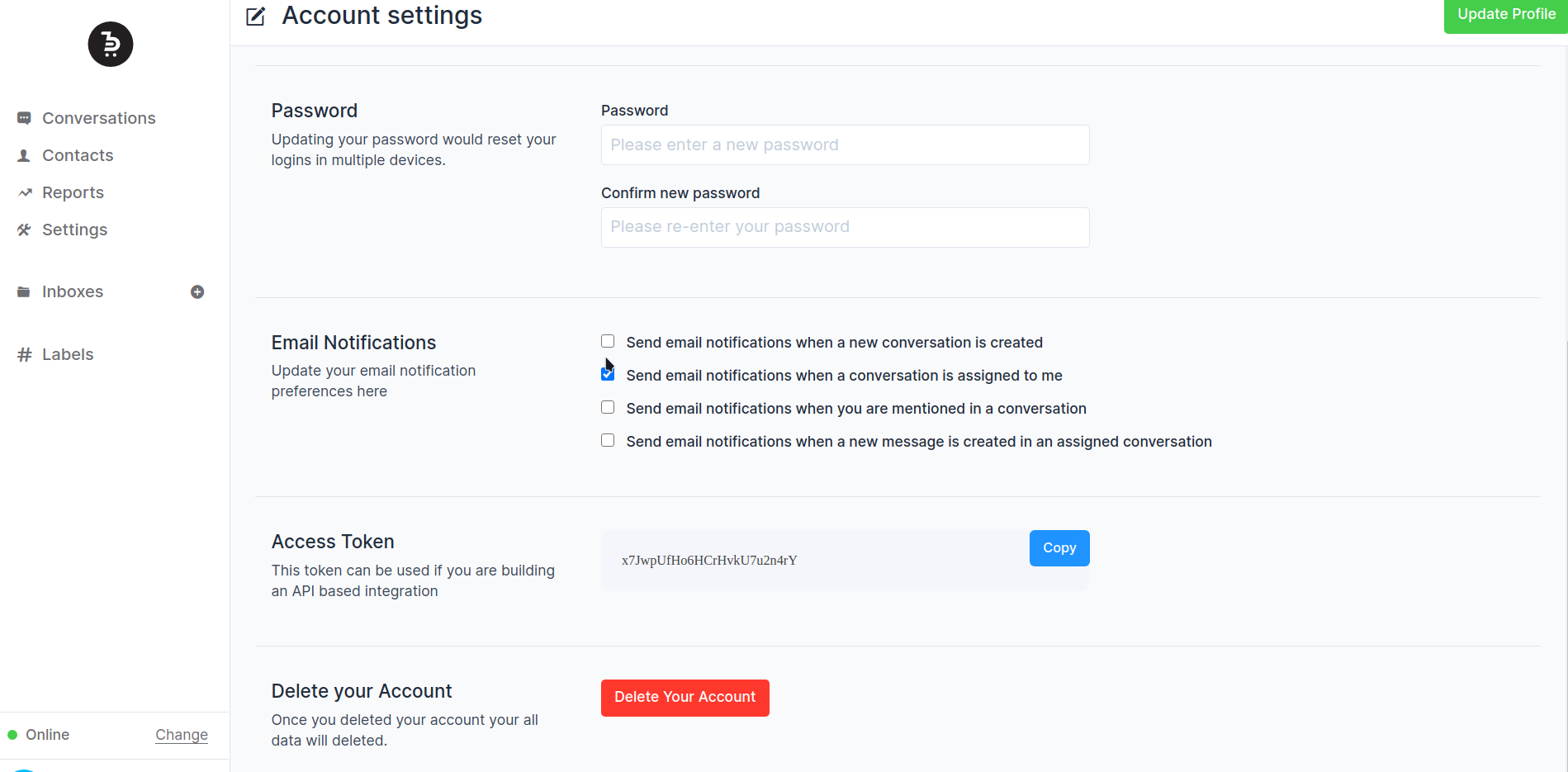
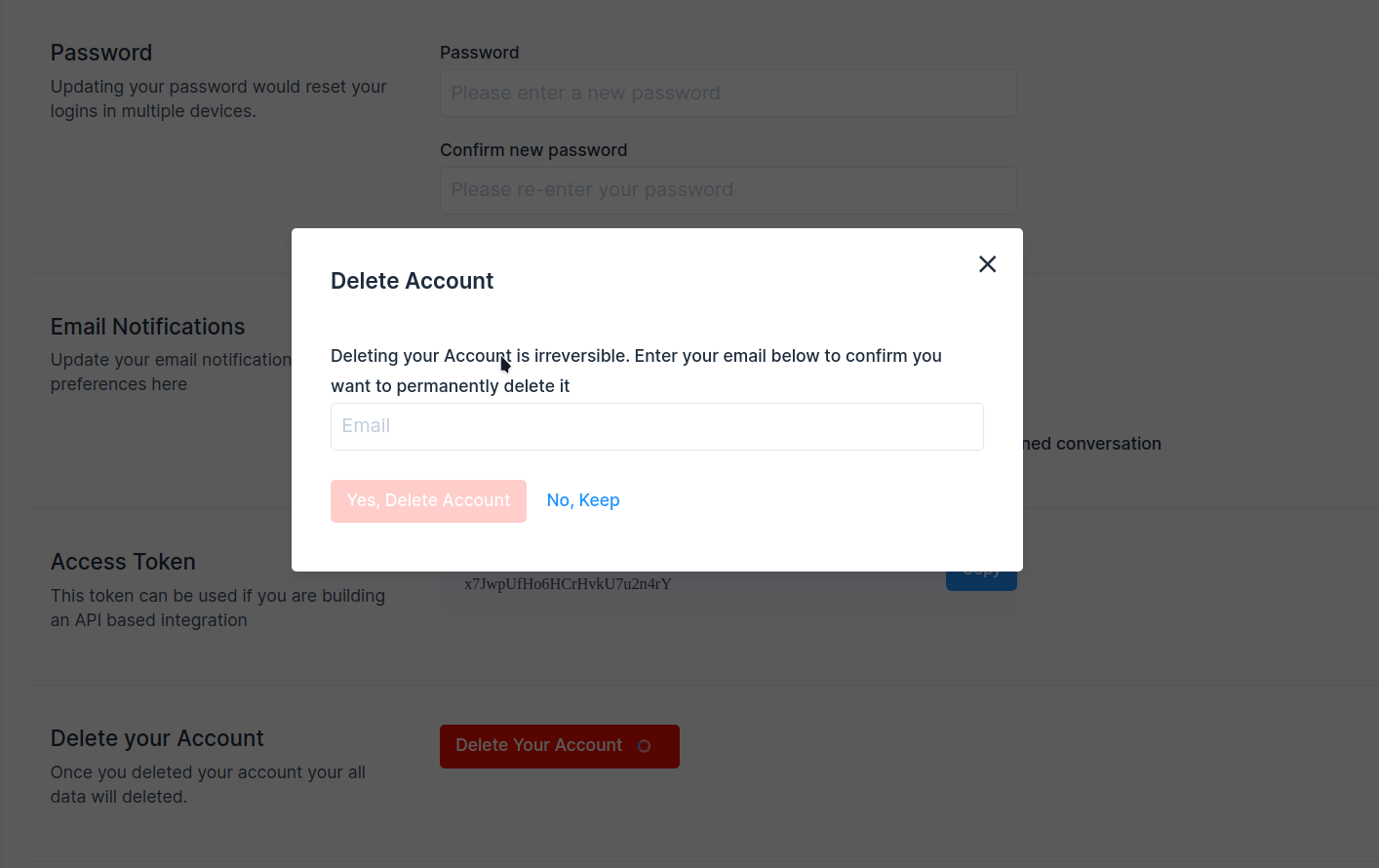
## Description
Add account delete option in the user account settings.
Fixes#1555
## Type of change
- [ ] New feature (non-breaking change which adds functionality)
## Checklist:
- [ ] My code follows the style guidelines of this project
- [ ] I have performed a self-review of my own code
- [ ] I have commented on my code, particularly in hard-to-understand
areas
- [ ] I have made corresponding changes to the documentation
- [ ] My changes generate no new warnings
- [ ] I have added tests that prove my fix is effective or that my
feature works
- [ ] New and existing unit tests pass locally with my changes
- [ ] Any dependent changes have been merged and published in downstream
modules
---------
Co-authored-by: Sojan Jose <sojan@pepalo.com>
Co-authored-by: Sojan Jose <sojan.official@gmail.com>
Co-authored-by: Muhsin Keloth <muhsinkeramam@gmail.com>
https://github.com/chatwoot/chatwoot/pull/10888 introduced a bug in the
conversation editor since we were using the templates , email and phone
number payloads in contactable inboxes . temporary fix for this, we need
to rework this fix.
- Fixed Firecrawl webhook payloads to ensure proper data handling and
delivery.
- Removed unused Robin AI code to improve codebase cleanliness and
maintainability.
- Implement authentication for the Firecrawl endpoint to improve
security. A key is generated to secure the webhook URLs from FireCrawl.

---------

Co-authored-by: Pranav <pranavrajs@gmail.com>
This PR allows migration of legacy GMail inbox users to new OAuth based
inbox

## How to test?

1. Create an inbox from the seed data and set it's IMAP address to
`imap.gmail.com` from the UI
2. Open `rails console` and run the following

   ```
   inbox = Inbox.find(100) # use your inbox id here
   channel = inbox.channel
   channel.update(email: 'hello@chatwoot.com')
   channel.prompt_reauthorization!
   ```
3. This will show the prompt on the UI. Once you click on Reauthorize,
it should open Google Auth. Reauthroize with the same email address as
used in the inbox and it should start working as usual

### Setting up ENV

```sh
GOOGLE_OAUTH_CLIENT_ID=<some-hash>.apps.googleusercontent.com
GOOGLE_OAUTH_CLIENT_SECRET=<client-secret>
GOOGLE_OAUTH_CALLBACK_URL="http://localhost:3000/omniauth/google_oauth2/callback"
```
The `before_type_cast` method sometimes returns a string for
`message_type`, creating inconsistencies in different payloads. This
pull request will remove all `before_type_cast` usage and replace it
with `to_i` methods.
Remove the `user.permissions` field and resolve the permissions directly
from the accounts array in the user. This change ensures that the cache
or previous values from the last active account don't affect the
permissions.

In this PR:
- Remove user.permissions usage, replace it with getUserPermissions
method.
- Remove json.permissions from user.json.jbuilder